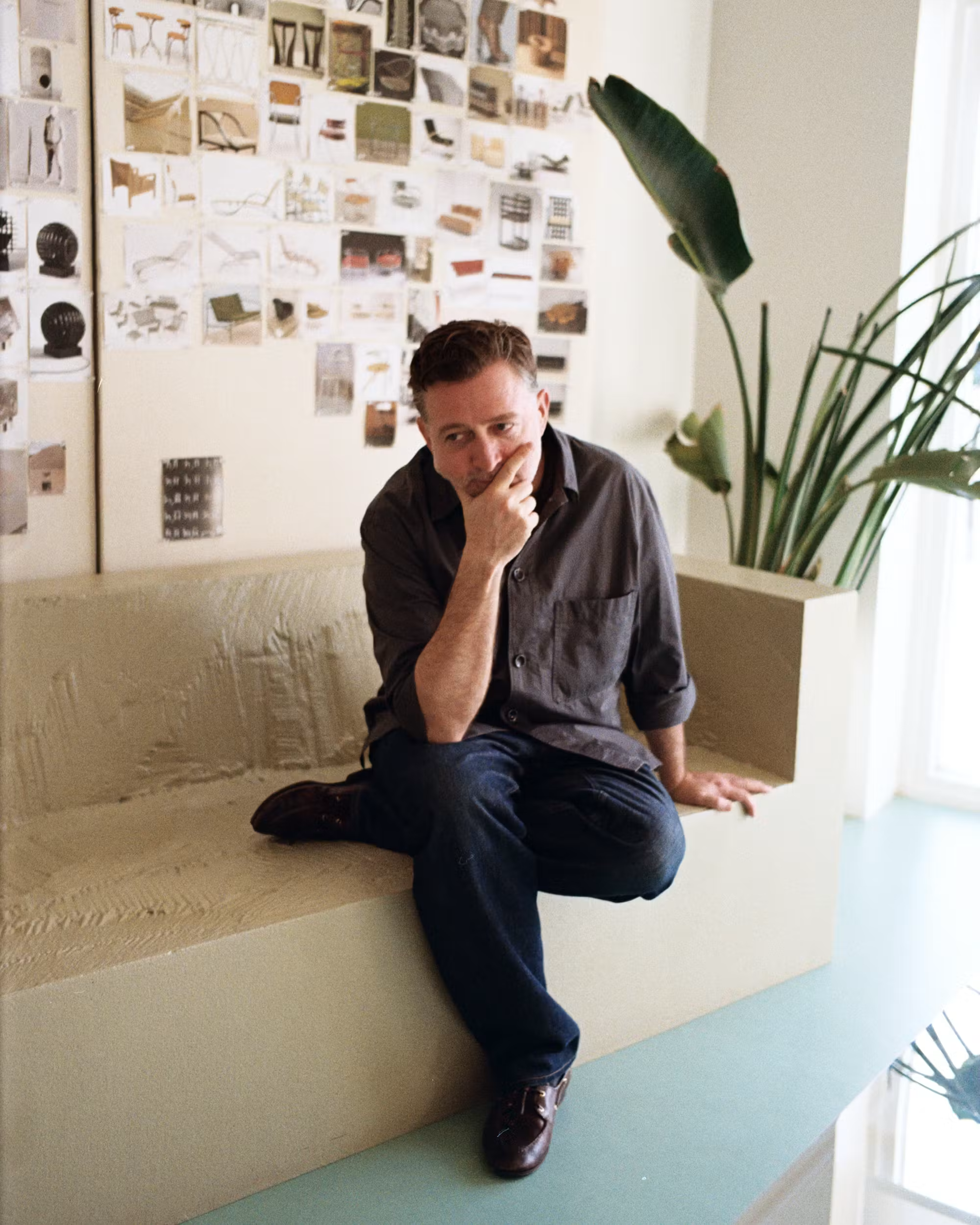
Why Jay-Z, Stussy, and Chanel Love This Design Genius
Willo Perron’s legendary career has made him the go-to for everyone from furniture manganate Knoll to Beyoncé.
Consider the garbage can. Not many people do — it’s perhaps one of the least-considered items in the home. But not many people are Willo Perron. Somewhere in Paris, the visionary designer, now in his early fifties, is sitting on a vintage Otto Zapf sofa thinking about trash. He’s decorating a new place, and he is having trouble finding a receptacle that meets his standards. “It’s a really simple thing that’s not done well,” he says. So, he has started drawing them himself.
Perron, after all, has forged a career out of rethinking things that others take for granted. He came up in the creative department of underground hip-hop label Rawkus Records and designed the visual language of St. Vincent’s MASSEDUCTION, along with Rihanna’s floating Super Bowl stage and Beyoncé’s Cowboy Carter tour. The musicians he worked with kept asking him to help with their homes, Perron told Wallpaper*. And a coffee meeting with Knoll’s creative director was the beginning of a longstanding partnership.
It’s Perron’s furniture work — for Knoll, for USM Haller, for himself — that has connected most broadly. His pieces, many of which emerged as prototypes for clients or for his own spaces out of a trashcan-like need, have become coveted by a certain artistic class. They have a distilled, napkin-sketch quality, minimal and exact but also loose — the work of an expert hand and an even more highly trained eye. Plus, the Knoll couches are easier to incorporate into your life than a Rihanna set.
We spoke to Perron about the difference between furniture and other design disciplines, the European versus American markets, and why he’s moving away from moodboards.
Has the furniture bug been there the whole time?
Design was innate in a weird way. I have an older brother who’s also a designer. He would buy vintage books; there were these Letraset catalogs my aunt bought us as kids. I was really fascinated by the idea that there was a creative hand in everything: packaging, clothes, typography, the chair you sat on. You could make the version you wanted. It’s always been there. I think I’m too pragmatic or neurotic or nervous to be an artist.
It sounds like you prefer working within a framework, as opposed to the more open-ended process of creating art.
I like parameters, and I like problems. They have a negative connotation for most, but for me problem-solving is the core of everything I do. Coming up with solutions for things, I think that’s the essence of design. Obviously there’s an aesthetic layer, but that sits second for me.
How do you approach solving problems at Knoll’s scale, versus for your own furniture projects?
Half of my furniture comes from interior projects we’ve done, including the Pillo couch for Knoll, which started really giant in somebody’s house. I couldn’t find anything on the market at the scale I wanted. Then, we made it human-sized. The other half is things I can’t find for my house that I want. But I also think it’s nice to start at the essence, which is the opposite of what I just said. The Sausage Sofa was sense-memory. Growing up, we had neighbors with a giant bean bag thing in their living room; we’d go there and lay for hours. I made it at the scale I remember, but it’s bigger because I’m bigger.
We talked a bit about the design challenges in your new home — the issue of the trash can. What has it been like to outfit that space?
I got a place in Paris. I’m here a lot as a visitor, but I’ve never had to buy basic things. It re-engages you: If you had to buy a toaster, where would you go? And Europeans are funny. They might have an actual toaster store. Even if you really care about how things look, you might not have had to engage with a toilet brush in America; you’d scroll through some options online and pick out a not-bad one. But here they literally have bathroom accessory stores.
It’s in the air there. What’s the difference between the North American design environment and the European one?
There’s a lot more “design” in Europe because there are no standards. As in, there’s no standard white bulb. In America we have the one junction-box-size light switch. And so everything is considered. There are so many faucets and switches here that it becomes comedic. It’s great, though. Designers aren’t just doing a junction-box-size light switch. You’re making the light switch you want.
How is your furniture work different from the rest of your design practice?
Client work is very much, “Here’s the project, budget, timeline.” You’re working against a clock. Whereas in furniture, I can let it simmer. I have a lot of half-started ideas: I see something or flip through a book and figure out the solution, and in the meantime, it sits there and gathers dust. My preferred way of working is starting a project myself and not really having a total end goal. The Bun chair we did for Knoll was something I noodled around in my office; it sat in a corner for a while. There’s something good about not being attached to a brief or mandate.
A lot of the other stuff I do is not quite as intimate. Furniture is very close to the person so it becomes about very subtle, small details: materiality, how it feels and wears. And it doesn’t have the same purpose anymore. The depth of couches is different now because we don’t sit formally and upright anymore, and people are less and less ready to compromise comfort.
What’s the research process like for you now? Is it more or less formal at this stage in your career?
The way you did research for the past 30 years was discovery: You’d go to a used bookstore and find something incredible you didn’t know about and build a visual library. There were recesses on the internet. But now, the portals where people do research, everybody’s looking at the same shit. There are a bazillion creative agencies and designers, and they’re all just looking at these few resources. If you’re really clever, you can go past this, but everybody still winds up in the same pool. We’re looking at a finite amount of things.
And so there’s an experiment I’m starting with the studio: How do we not moodboard or research with pinned images? We know the images, but what we do as a studio is come up with a point of view. If everything starts to bleed into each other, we fail. We’re not off them yet, but they’re really such a deficient way of communicating. You’re saying, “Look at these things that you’re for sure going to like that already exist.” It’s an existent energy. Seeing successful things on a board — of course it works. People have seen them, and seen the reaction to these items, versus taking a chance on something that’s completely abstracted to them.