14 of our Favorite Gearheads Tell Us About Their Daily Drivers
Rapper Larry June, WNBA legend Brittney Griner, model and chef Pierce Abernathy, and many others show off the cars that complete them.
Consider for a moment, if you will, a version of J.G. Ballard’s 1973 novel, Crash, in which all of the vehicles are replaced with self-driving cars. They wouldn’t collide with one another. There would be no climax of metal entanglements. Propelled by inhuman forces, the cars would simply refuse to bend to the perversions of the people who wanted to get off on ramming them together.
Can you imagine the sexual frustration? It’s enough to make a person go out and buy a Porsche.
Driverless cars are cold logistics given form: conveyance, cartage, chargeable weight. There is nothing to love about them in the same way there is nothing to love about a microwaveable meal or a Nespresso pod. A driverless car cannot cruise a Los Angeles avenue in the faint gloam of the evening or slow down so you can flirt with someone you think is cute from an open window in the humid damp of late summer. The driverless car does not know how to go nowhere.
To desire a piece of machinery that exists in opposition to that joyless march toward efficiency is, then, deeply sexy. Each person I spoke with, from fashion designer to chef to WNBA player, owns a car that sputters and vibrates and oozes fluids, grease slicking the gears and oil dripping from the chassis. They all share a desire to feel what they’re driving rather than turning it on and letting a computer take over.
These are the kinds of gearheads we can get behind: people who own Porsches, yes, but also some Benzes, a Honda, a G-Wagon, and a 1994 Japanese right-hander. People who are in it for the friction of a stalled engine or the ecstasy of a tuneup. People who are in it for the long haul.
Larry June Rapper San Francisco 2006 Mercedes-Benz SLR McLaren
Larry June remembers seeing the butterfly doors and spaceage side vents of the 2006 Mercedes-Benz SLR McLaren for the first time as a teenager. “It was in a music video, I can’t remember who. But from then on I had always wanted it,” he says. It took a couple decades, but June said he finally found one at a Beverly Hills dealership after his son encouraged him to start looking online. “When they shipped it up, that was my first time driving this mode,” he says. The brakes and steering were a little stiffer than he was used to, a byproduct of the car being a test ground for ambitious experiments in metals and structure. “It’s an older car with older technology than my other cars, but that’s what makes it dope,” he says. “It’s super light; the whole thing is carbon fiber.”
A love of cars runs in June’s DNA. His father had a rotation, and he remembers the lineups in San Francisco where neighbors would show off their rides. “I would see all the older guys pulling up in 5.0s, Grand Nationals, Vipers, the whole neighborhood had cars coming through,” he says. That also imbued a lesson: cars are meant to be driven. He takes the McLaren out a few times a week and has been able to test out the car’s legendary speed. It attracts some understandable attention from aficionados who probably feel the same way about the McLaren that June did as a teenager. “People want to take pictures, and I don't mind it, but I don't like the attention 24/7,” he says. “I only drive it early in the morning, by myself, get some coffee or juice, then park it and switch to another car.”
Brittney Griner Basketball player Arizona 1971 Chevrolet Chevelle Super Sport 454
For more than a decade, Brittney Griner would walk past the same 1971 Chevelle Super Sport parked at an auto body shop on her way to the Phoenix Mercury’s practice facility. Sometimes she’d stop, talk to the mechanics, and, when she felt bold, ask if the car was for sale. “Early on, I was still on that rookie salary, and it just wasn’t smart. I didn’t even have a house yet,” Griner says. That changed last year when she got a call from the shop. The owner wanted to sell Griner the car — but he wanted her Jeep as a trade. “So we did a little swap. I sent a little money with it, and boom, I got my Chevelle,” she says. She started turning heads the minute she turned on the engine. “When it finally cranked up inside that trailer, my neighbors started coming out because they knew something was worth coming out for,” she says.
The run of Chevelles from the late 1960s to the early 1970s is special to Griner because her father had a 1968 that he begrudgingly sold many years ago. When she bought her car, she called her dad and teased him. “I said, ‘Guess what I got?’ and he knew immediately,” she says. That first night with the car, she put her wife in the passenger seat, arm around her shoulder, cruising the neighborhood while the older residents gave thumbs-ups out their windows.
The Chevelle 454 is a Chevy Big Block engine, loud and simple and easy to work on. Those are all attributes Griner applies to herself with some satisfaction. “I think I’m a classic,” she says, laughing. “I’m easy. I’m low maintenance. I don’t need all that extra. The simplicity of the car and the raw muscle and the lines it has. I feel like that’s me.”
When the time comes, the car will go to her son, who is two and already recognizes the sound of the engine from inside the house. There will be rules attached: “He cannot get rid of it,” Griner says. “Or I will haunt him for the rest of his life.”
The Japanese Mazda from Facebook Marketplace
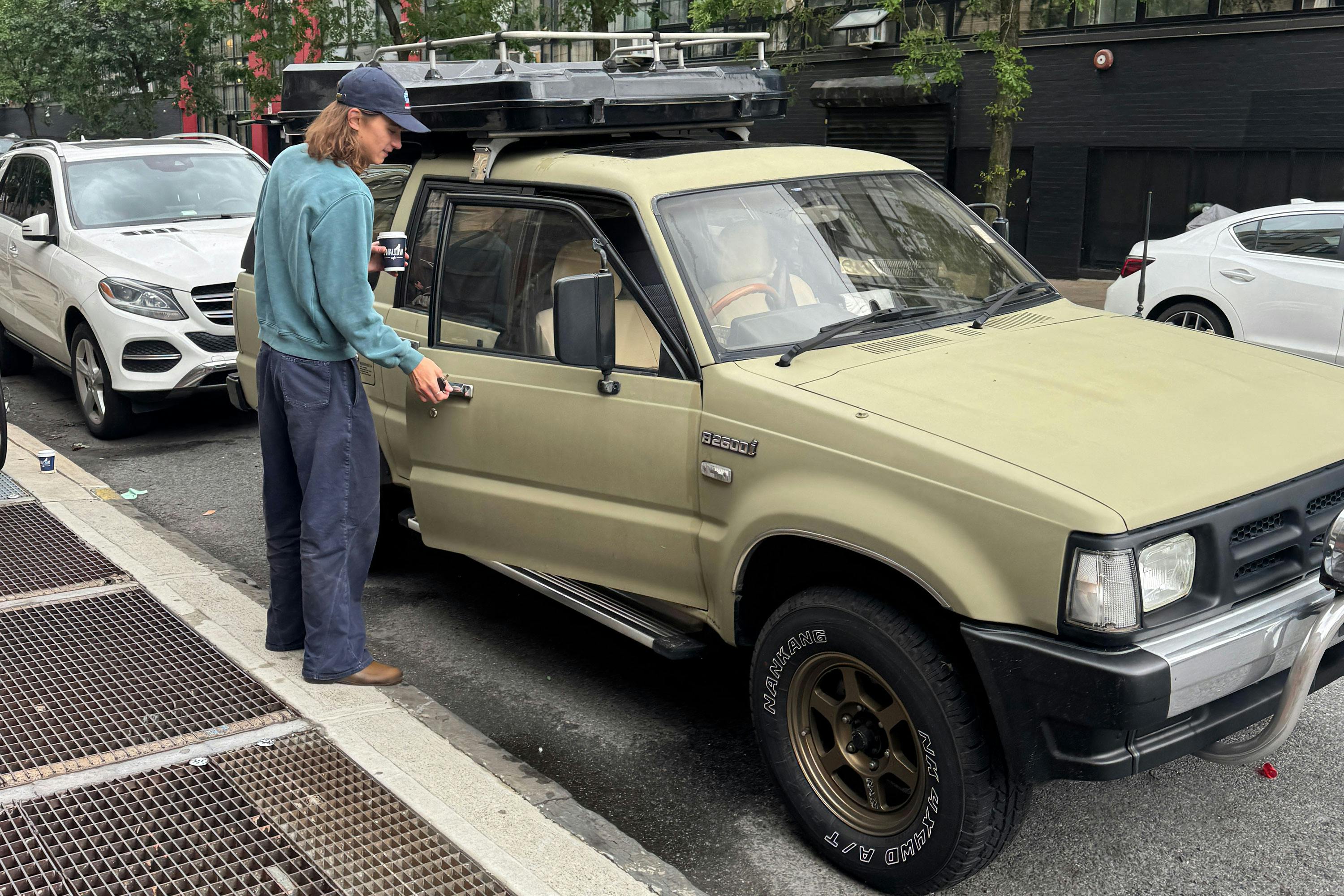
Pierce Abernathy Model and chef New York 1994 Mazda Proceed Marvie Camper
Pierce Abernathy will tell you, without much prompting, that he has the best Facebook Marketplace algorithm of anyone he knows. This is how he found the 1994 Mazda Proceed Marvie, a right-hand-drive Japanese-market SUV with a camper conversion in the back. It was listed by a seller in Virginia who had imported it and clearly cared for it with unusual devotion. Abernathy drove it back to New York City himself. That first hour on the highway, sitting on the right side for the first time in his life, was a little frightening. “Anyone who gets in the car to drive it takes a second to get used to it,” he says.
The Mazda has original paint, low mileage, and an interior that the previous owner had modified with quiet intentionality. The whole thing was function over form. When Abernathy took it to a mechanic’s shop for its first inspection, the guy called everyone else over to look at the engine. “I have some sense of pride,” Abernathy says, “even though I know nothing [about what’s] going on in there. I just bought the car. But I’m like, ‘Yeah, I bought a good one.’”
He parks it on the street and is at peace with the dents and dings that come with that arrangement. The car was made to be used, and using it is its own form of care. The aux cord connection between his radio and his phone is especially mercurial; he’ll sometimes lose his driving music if he shifts his knee in the wrong way. Still, “I can’t imagine having a new car,” he says. “All these quirks are endearing to me; I feel closer to the practice of driving. It’s this nostalgia that doesn’t even come from my own life.”
The Mercedes-Benz 300 with Brooklyn swagger
Jon Caramanica Journalist New York 1993 Mercedes-Benz 300 CE
“It’s a dope-boy car,” Jon Caramanica says when asked why he wanted this particular model of Benz 300 series. “It’s from a certain generation of cars that were flashy in a very specific time in New York City history. They are beautiful and functional, and they have a panache that is very hard to replicate.” Caramanica inherited his family’s 1983 Mercedes 300 CD and “drove it into the ground” before finding the 1993 model in 2022. The ’83 is now in storage in upstate New York, although Caramanica has an abiding fondness for the big-bodied family heirloom. “I’d have it parked in my living room if I could,” he says.
The journalist and pop music critic at The New York Times grew up in Mill Basin and Sheepshead Bay on Brooklyn’s southern edge, a rare corner where driving is the preferred way to get around. His dad owned a body shop on 54th Street, and Caramanica remembers spending days there watching expert mechanics repair seemingly lost causes. But Caramanica’s parents understood how tempting that environment could be. “They didn’t let me get under the hood or tinker. They didn’t want that life for me,” he says.