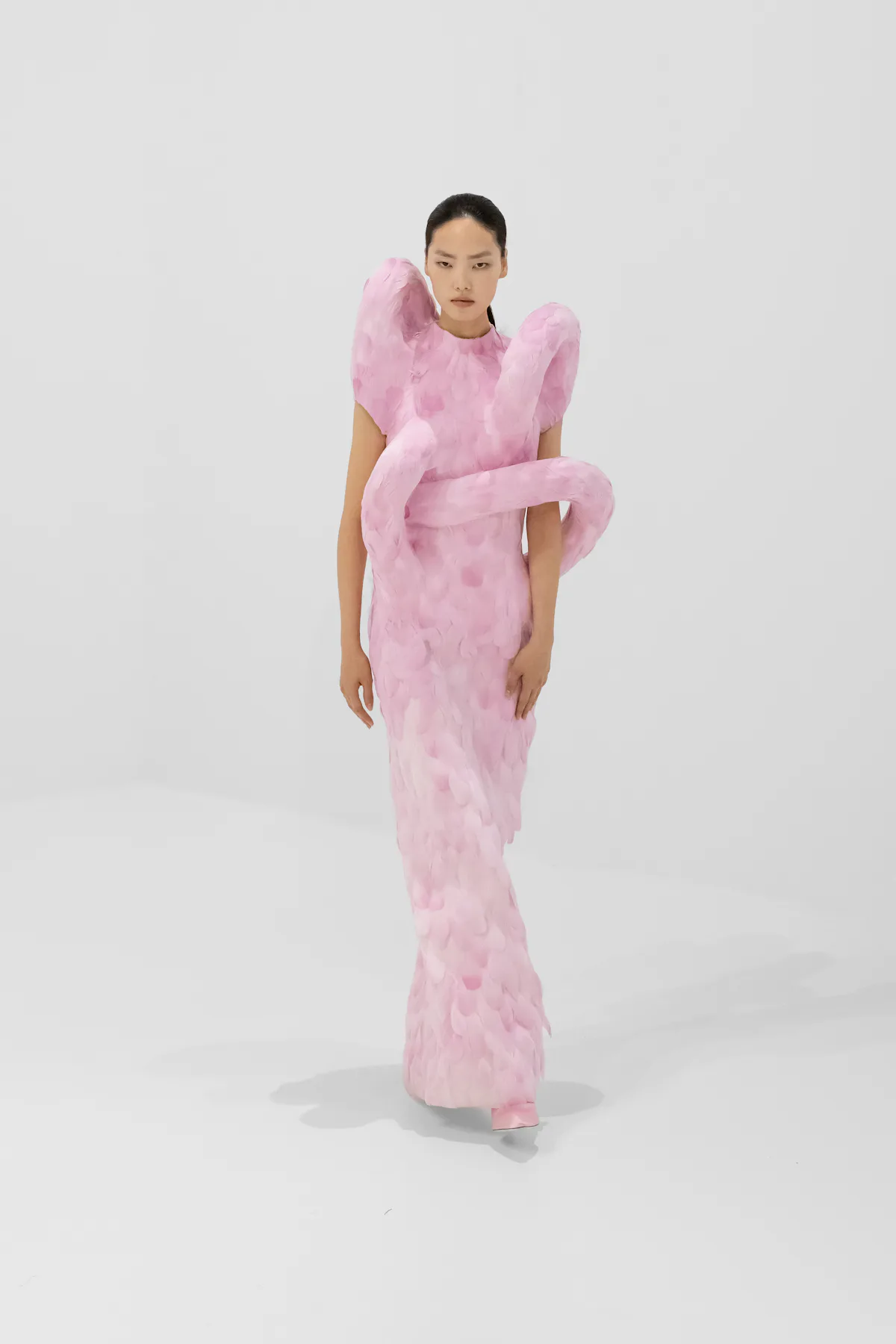
Duran Lantink Won’t Rest on Nostalgia at Jean Paul Gaultier Couture
For fall 2026, the designer sidestepped the brand’s obvious signatures and focused instead on bodysuits, sculptural tailoring, and upcycling.
After a period of rotating guest couturiers—including Chitose Abe, Glenn Martens, and Haider Ackermann—Jean Paul Gaultier’s couture entered a new chapter Wednesday evening. Duran Lantink, the maison’s new creative director, made his highly anticipated couture debut in the grand ballroom of its beaux arts headquarters on rue Saint-Martin with a collection titled “Tech Couture,” following two acclaimed ready-to-wear showings. The space, which has hosted couture shows since Gaultier himself was at the helm, was cocooned entirely in white padded fabric—a clean slate. Gaultier watched from the front row as Lantink delivered a collection that felt unmistakably JPG while resisting a straightforward exercise in nostalgia. Lantink sidestepped the obvious signatures of marinière stripes and cone bras in favor of a more oblique conversation with some of Gaultier’s other enduring fascinations, such as bodysuits, Aran knits, men in couture, sculptural tailoring, and upcycling.
Upcycling was key to understanding the synergy between Gaultier and Lantink’s couture visions. A wasp-waist trucker jacket made from upcycled denim offered a subtle callback to Gaultier’s own spring 1997 couture debut, which had featured Lesage-embroidered denim made from his own old pairs. But the more revealing reference was cotton guipure lace from Gaultier’s fall 2008 “Cages” collection, used here on an armor-like dress with cone spikes at the hips and shoulders. That earlier collection’s exoskeleton-esque crinolines, worn over other garments and even as headpieces, evinced a broader Gaultier interest: not simply accentuating feminine curves, but imagining new ways for all bodies to occupy space. It was a natural point of connection with Lantink, whose signature bulbous forms similarly treat the body as a canvas for reinvention.
“I see this collection as a laboratory for experimentation,” Lantink wrote in his show notes. The collection had a mad scientist-like sensibility, with as many inspirations as a vintage JPG outing, from Marie Antoinette and Charles James’s petal ball gown to Richard Lindner’s theatrical paintings melding human figures with machine-like elements. Collars jutted forward like a ship’s bow or morphed into biomorphic forms that swooped around the torso, while shoulder lines were pushed beyond extreme bodybuilder proportions. A number of looks sprouted bulges and massive tulle bustles extending not just from behind but in every direction. Lantink achieved these architectural effects through a synthesis of traditional couture techniques, such as corsets, cage crinolines, and boned panniers, with 3-D-printed flexible TPU and PA12, as well as industrial materials like wadding foam and polyester foam cores. One black mini crini encrusted with long glass tube beads fused panniers with repurposed honeycomb-cell padding, bringing couture’s historical architecture and industrial experimentation together in a single silhouette.